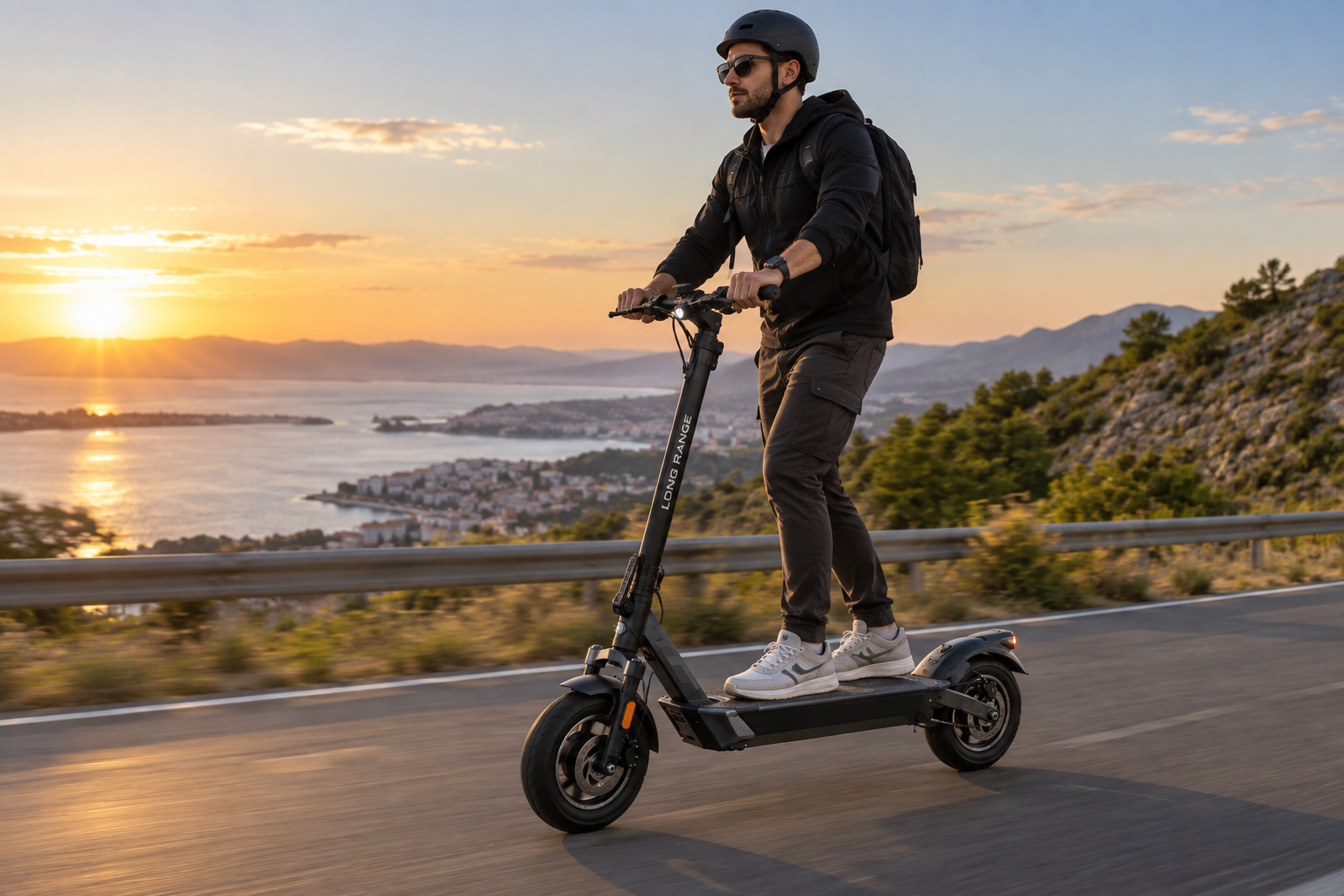
A long range electric scooter can make longer commutes, weekend rides, and everyday transportation more practical without requiring frequent charging stops. However, advertised range alone does not tell you how far a scooter will actually travel in your normal riding conditions.
Battery capacity, rider weight, speed, hills, tire pressure, temperature, and riding mode can all affect real-world distance. If you are comparing models, looking beyond the biggest range number can help you find a scooter that better matches your routes, comfort preferences, and charging routine.
What Makes a Long Range Electric Scooter Worth Considering?
The main reason to choose a long range electric scooter is straightforward: you want enough usable distance for your typical journey with some capacity left over.
Manufacturers generally calculate range under specific testing conditions. Your results may differ once hills, frequent acceleration, rider weight, wind, road surfaces, and colder temperatures enter the equation.

Instead of choosing a model solely because it advertises an impressive electric scooter range, compare the claimed figure with the distance you realistically need.
For example, if your daily round trip is 20 miles, buying a scooter advertised for exactly 20 miles leaves little room for changing conditions. A model with additional capacity may give you more flexibility as the battery ages or your route changes.
How Much Range Do You Actually Need?
Start by calculating your longest regular round trip. Add any additional distance you may travel for shopping, errands, or unexpected detours.
For shorter urban trips, maximum range may be less important than portability. Longer commuters may place greater value on battery capacity, riding comfort, charging convenience, and reliability.
A commuter electric scooter should ideally fit your actual transportation routine rather than simply having the largest battery available. Larger batteries usually add weight, so extra range can make a scooter more difficult to carry upstairs, place in a vehicle, or store indoors.
Think About Your Typical Journey
Before comparing specifications, ask yourself:
- How many miles or kilometers do you normally travel each day?
- Can you charge the scooter at your destination?
- Does your route include steep or extended hills?
- Will you need to carry the scooter regularly?
- Do you frequently ride at higher speeds?
- Will you use the scooter for errands in addition to commuting?
These questions can quickly narrow your options.
Battery Capacity Matters More Than the Range Claim Alone
Battery specifications provide useful context when comparing scooters. Battery capacity is commonly expressed in watt-hours, or Wh. In general, greater capacity provides more stored energy, although motor efficiency, scooter weight, speed, and other factors still influence usable distance.
A high capacity electric scooter may make sense when you regularly travel farther or have limited charging opportunities during the day.
However, a larger battery has trade-offs. It can increase the scooter’s overall weight, price, and charging requirements.
Why Real-World Range Can Be Lower Than Advertised Range
Range estimates are useful for comparing products, but they should not be treated as guaranteed travel distances.
Several variables can reduce how far a scooter travels on one charge.
Rider Weight
Moving additional weight requires more energy. Riders closer to a scooter’s maximum load rating may therefore experience shorter range than riders used during controlled testing.
Always check the manufacturer’s maximum payload specification before purchasing.
Riding Speed
Maintaining higher speeds generally requires more energy. Riding at a moderate, consistent pace may help extend usable distance compared with frequent hard acceleration and sustained high-speed riding.
Hills
Repeated or steep climbs put additional demand on the motor and battery. If your commute includes significant elevation changes, consider them when deciding how much battery capacity you need.
Temperature
Lithium-ion battery performance can change in cold conditions. Riders in colder climates may notice reduced usable capacity compared with mild-weather riding.
Tire Pressure and Road Conditions
Underinflated tires can increase rolling resistance. Rough surfaces, loose gravel, and uneven roads may also require more energy than smooth pavement.
Motor Performance and Range Need to Work Together
A powerful motor can be useful for acceleration and climbing hills, but motor wattage should not be considered separately from battery capacity and controller performance.
For an electric scooter for adults, check the rated motor output, maximum rider weight, climbing capability, and available riding modes.
If your route is mostly flat, extreme motor power may provide little practical benefit while potentially adding cost and weight. If you regularly encounter hills, however, adequate motor performance becomes more important.
Remember that operating continuously in the scooter’s highest-performance mode may reduce range.
Compare Charging Time Before Buying
Long-distance capability becomes less convenient when the scooter needs most of the day or night to recharge.
Check the manufacturer’s stated electric scooter charging time and whether the supplied charger supports the battery’s full capacity efficiently. Some larger batteries naturally require longer charging periods.
Think about where charging fits into your schedule. Overnight charging may be sufficient for daily commuting, while riders making multiple long journeys in one day may need greater flexibility.
Follow the manufacturer’s charging instructions and use compatible charging equipment.
Comfort Becomes More Important on Longer Trips
A scooter that feels comfortable for a five-minute test ride may feel very different after 30 or 40 minutes.
When comparing longer-range models, pay attention to:
- Deck dimensions and standing position
- Handlebar height and width
- Tire size and type
- Suspension design
- Overall stability
- Brake feel and control placement
Larger pneumatic tires can help absorb some road imperfections, while suspension may improve comfort on uneven surfaces. These features can also add weight and maintenance requirements, so consider how and where you ride.
Braking and Visibility Deserve Close Attention
Longer trips can expose you to a wider variety of traffic, road surfaces, and lighting conditions. Safety-related equipment should therefore be part of your comparison.
Also examine the headlight, rear light, brake light, reflectors, and turn signals where available.
Equipment requirements and scooter regulations vary by location, so check the rules that apply where you plan to ride.
Tires Can Affect Comfort, Maintenance, and Range
Electric scooters commonly use pneumatic, tubeless, or solid tires.
Pneumatic tires generally provide better cushioning but can puncture and require pressure checks. Solid tires reduce puncture concerns but may transmit more vibration to the rider.
Tire size also matters. Larger wheels can provide greater stability over uneven pavement, although the complete suspension and chassis design determines overall ride quality.
There is no universally best tire configuration. Your road conditions and willingness to perform routine maintenance should guide the decision.
Portability Is the Trade-Off You Should Not Ignore
Longer range typically requires more battery capacity, and batteries are heavy.
A scooter that performs well on a long commute may be inconvenient if you need to carry it up several flights of stairs every evening. Check the total weight rather than assuming a folding mechanism automatically makes a scooter easy to transport.
Consider folded dimensions as well. If you plan to combine scooter travel with public transportation or store it underneath a desk, physical size can matter almost as much as range.
What Features Should You Compare?
When narrowing your options, compare specifications that affect everyday ownership rather than focusing on one headline number.
| Feature | Why It Matters |
|---|---|
| Advertised range | Provides a starting point for estimating usable distance |
| Battery capacity | Helps you compare the amount of stored energy |
| Motor rating | Influences acceleration and hill performance |
| Maximum load | Shows whether the scooter supports your weight and belongings |
| Charging duration | Determines how quickly the scooter can be prepared for another ride |
| Scooter weight | Affects carrying and storage |
| Tire type | Influences comfort and maintenance |
| Suspension | Can improve longer rides over uneven surfaces |
| Braking system | Affects stopping control |
| Warranty | Helps clarify coverage for major components |
Specifications should always be verified on the manufacturer’s current product page or manual because details can vary between versions and markets.
Is a Long Range Electric Scooter Worth the Extra Cost?
It may be if you regularly travel distances that smaller-battery scooters cannot comfortably cover.
Paying more solely for unused range, however, may offer limited value. A heavier and more expensive scooter can become inconvenient if your journeys are consistently short.
Consider total ownership rather than purchase price alone. Tires, brake components, replacement batteries, servicing, accessories, and electricity for charging can all contribute to ongoing costs.
The better value is usually the scooter whose capabilities closely match how you actually plan to use it.
Questions to Ask Before You Buy
How far will you travel on a normal day?
Calculate your regular round trip and allow additional capacity for changing riding conditions.
Can you charge at work or another destination?
Destination charging may reduce the amount of range you need from a single charge.
Will you carry the scooter?
If so, weight and folded dimensions deserve as much attention as battery capacity.
Are there hills on your route?
Look closely at motor performance and remember that climbing can increase energy consumption.
What type of roads will you use?
Poor pavement may make larger tires or suspension more valuable.
Can replacement parts be obtained easily?
Check the availability of tires, brake components, chargers, batteries, and authorized service before purchasing.
Choosing the Right Scooter for Longer Journeys
Finding the right long range electric scooter involves balancing distance, battery capacity, motor performance, comfort, portability, charging, and cost.
Start with the distance you genuinely need to cover, then compare models with enough reserve capacity for real-world conditions. After that, examine scooter weight, braking, tires, suspension, warranty coverage, and replacement-part availability.
A scooter with the highest advertised range is not automatically the most practical option. The stronger choice is one that provides enough usable distance while remaining comfortable, manageable, and suitable for your everyday routes.