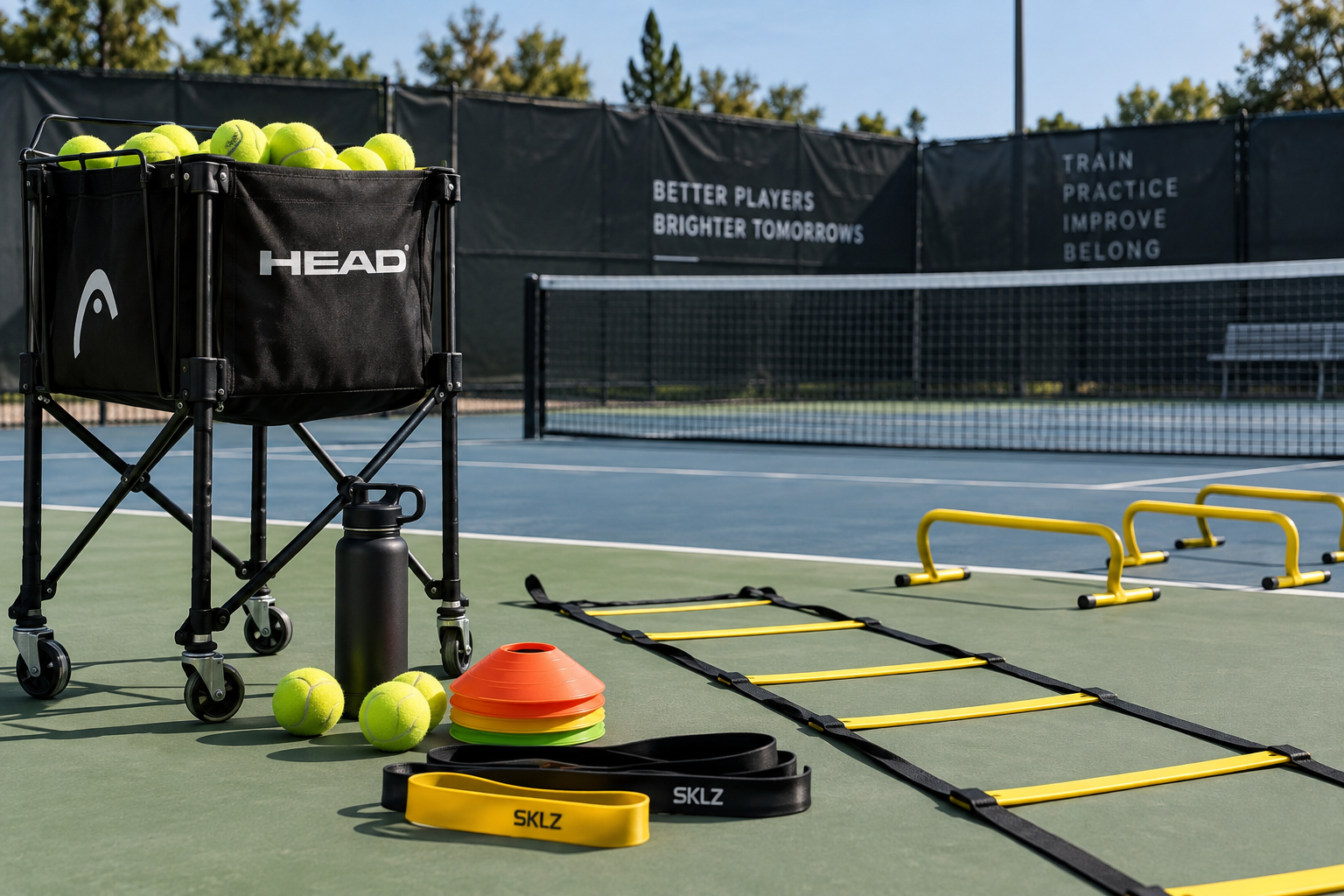
Choosing the right tennis training equipment can make your practice sessions more structured, convenient, and focused on specific areas of your game. From improving stroke repetition to developing footwork and accuracy, different tools serve different purposes.
Before buying anything, consider your current skill level, available practice space, training frequency, and the areas you want to develop. Some players may benefit from simple targets and cones, while others may prefer automated equipment that allows them to practice without a partner.
What Tennis Training Equipment Is Worth Considering?
The most useful tennis training equipment depends on what you want to accomplish during practice. A beginner working on consistent contact has different needs from an experienced player trying to sharpen placement, movement, or reaction speed.
Six useful product-related terms to know while comparing options are:

- tennis ball machine
- tennis rebounder
- tennis practice net
- tennis training aids
- tennis agility equipment
- tennis target trainer
You do not necessarily need every type. A smaller selection that directly supports your training goals may provide better value and take up less storage space.
Ball Machines for Repetitive Stroke Practice
A tennis ball machine can be useful when you want a steady supply of balls without depending on another player. Depending on the model, machines may let you adjust feed rate, ball speed, spin, trajectory, and side-to-side delivery.
Entry-level machines generally focus on straightforward ball feeding. More advanced models can offer programmable drills, oscillation, remote controls, and different spin settings.
When comparing machines, pay attention to:
- Ball capacity
- Battery runtime and charging requirements
- Speed and spin adjustments
- Oscillation features
- Machine weight
- Wheels and handles
- Remote-control options
- Storage requirements
Portability deserves particular attention if you frequently move between your home, vehicle, and tennis court. A feature-packed machine may be less convenient if it is difficult to transport.
Rebounders for Solo Practice in Smaller Spaces
A tennis rebounder gives the ball a return surface so you can practice repeated shots without another player. It may work well in a driveway, backyard, garage, or dedicated training area, depending on the rebounder’s dimensions and the space available.
Some models use tightly stretched netting, while others have adjustable angles that change the ball’s return trajectory.
Check the frame construction and stability before buying. A lightweight model can be convenient to move, but it should remain stable when repeatedly struck by tennis balls. Foldable designs may also make storage easier.
Practice Nets for Home and Portable Setups
A tennis practice net can help create a defined hitting area when you do not have access to a full court. Portable options can be particularly useful for gardens, driveways, sports halls, or other suitable practice spaces.
Size is one of the first details to compare. A compact net may suit controlled drills, while a wider design provides additional room for movement and directional practice.
Look at assembly requirements as well. Quick-connect frames and carrying bags can make portable models more convenient if you plan to set up and pack away your equipment frequently.
Training Aids for Technique and Repetition
The category of tennis training aids covers a broad selection of products designed for particular drills or aspects of technique. Options can include swing trainers, resistance tools, serve-training devices, ball holders, and specialized practice accessories.
Before buying a technique-focused product, identify the specific problem you are trying to address. A specialized tool makes more sense when it has a clear role in your practice rather than simply adding another piece of gear to your collection.
You should also check whether a particular device is appropriate for your experience level. Some tools are straightforward enough for independent practice, while others may be more useful when incorporated into coaching sessions.
Agility Tools for Movement and Footwork
Good court movement involves balance, coordination, acceleration, and quick directional changes. Tennis agility equipment can help you organize drills that focus specifically on those physical skills.
Common options include cones, agility ladders, hurdles, resistance bands, and court markers. These products are generally compact, making them relatively easy to transport and store.
For example, cones can mark movement patterns around a baseline, while an agility ladder can provide a structured way to practice quick foot placement. The equipment itself does not replace tennis-specific movement practice, but it can add variety and structure to conditioning sessions.
Target Trainers for Placement Drills
A tennis target trainer can give you a visible objective when practicing serves, groundstrokes, or volleys. Targets may attach to nets, sit on the court, or create designated zones where you try to place the ball.
Size and visibility matter. Larger targets can make sense when developing basic directional control, while smaller targets can create a more demanding placement drill.
Durability is another consideration because repeated ball impacts and outdoor conditions can gradually wear down lightweight materials.
How Should You Compare Different Training Products?
Price matters, but it should not be the only factor behind your choice. Think about how frequently you expect to use the product and how easily it fits into your normal practice routine.
Consider these factors before purchasing:
Training purpose: Decide whether you want to work primarily on strokes, serves, accuracy, footwork, conditioning, or solo repetition.
Available space: Measure your practice and storage areas before ordering larger products.
Portability: Look at weight, folded dimensions, wheels, handles, and carrying cases if you regularly transport your gear.
Adjustability: Adjustable settings can allow one product to support several drill variations.
Construction: Examine frame materials, netting, fasteners, and other components that receive frequent impacts or outdoor exposure.
Setup time: Equipment that takes too long to assemble may become inconvenient for shorter training sessions.
Replacement parts: For mechanical products, check whether replacement batteries, wheels, chargers, remotes, or other components are readily available.
Is Expensive Training Equipment Necessary?
Not necessarily. Higher prices can bring additional features, stronger construction, automation, or greater adjustability, but those features only provide practical value when you actually use them.
If you are new to structured tennis practice, starting with basic products can help you determine which drills fit your routine. You can then invest in more specialized gear after identifying where additional functionality would be useful.
For example, cones and simple targets may be sufficient for movement and placement drills. Automated ball feeding becomes more relevant when you regularly practice alone and want repeated deliveries.
What Equipment Is Useful for Beginners?
Beginners generally benefit from equipment that keeps practice straightforward. Simple targets, portable nets, cones, and rebound systems can support repetition without introducing complicated settings.
Focus first on products that encourage consistent practice. A sophisticated device with numerous settings may offer limited value if you only need basic repetition.
If you are taking lessons, you can also ask your coach which products complement the drills you are already performing. This can help prevent spending money on equipment that duplicates existing training activities.
What Should Intermediate and Advanced Players Consider?
More experienced players may want greater control over drill difficulty. Adjustable ball delivery, spin variations, smaller targets, resistance tools, and configurable movement drills can provide additional training options.
At this stage, versatility becomes more important. Equipment that supports several drill variations can allow you to change intensity, direction, placement, or movement patterns without replacing your entire setup.
However, specialized equipment should still match a specific training objective. More features do not automatically make a product more suitable for your needs.
Indoor Versus Outdoor Training Equipment
Your normal training environment can affect what you should buy.
Outdoor equipment may need stronger frames, weather-resistant materials, secure bases, and components designed to handle regular transportation. Indoor setups may prioritize compact dimensions, floor protection, quieter operation, and easy storage.
Always check manufacturer instructions regarding intended use. Products designed primarily for indoor environments may not tolerate prolonged exposure to rain, moisture, or direct sunlight.
Questions to Ask Before Buying
Before making your final choice, ask yourself:
What skill am you trying to develop? Choose equipment with a clear purpose.
Where will you use it? Confirm that your practice area has enough space and an appropriate surface.
Will you practice alone? Rebound systems and automated feeding equipment can be particularly relevant for solo sessions.
How often will you transport it? Weight and folded dimensions become more important when equipment regularly travels with you.
Can you store it easily? Large nets and machines can require considerably more room than cones, targets, or smaller accessories.
Are the additional features useful? Compare features according to your actual routine rather than automatically choosing the model with the longest specification list.
Building a Practical Tennis Training Setup
A useful training setup does not need to include every available gadget. Start by identifying one or two skills you want to develop and choose equipment that directly supports those goals.
For solo stroke repetition, a rebound system or automated feeder may make sense. For accuracy, targets can provide a visible objective. For movement practice, cones and other compact tools can create structured patterns around the court.
As your routine develops, you can add equipment where you notice a genuine need. This approach keeps your setup manageable while helping you spend your budget on products you are more likely to use consistently.
Choosing Tennis Training Equipment That Fits Your Practice Goals
The right tennis training equipment should fit your skill level, available space, budget, and normal practice habits. Rather than focusing on the largest collection of features, compare products according to the drills you actually plan to perform.
Check dimensions, adjustability, portability, construction, setup requirements, and storage before purchasing. When each piece of equipment has a clear role in your routine, it becomes easier to build structured practice sessions without filling your training space with unnecessary gear.