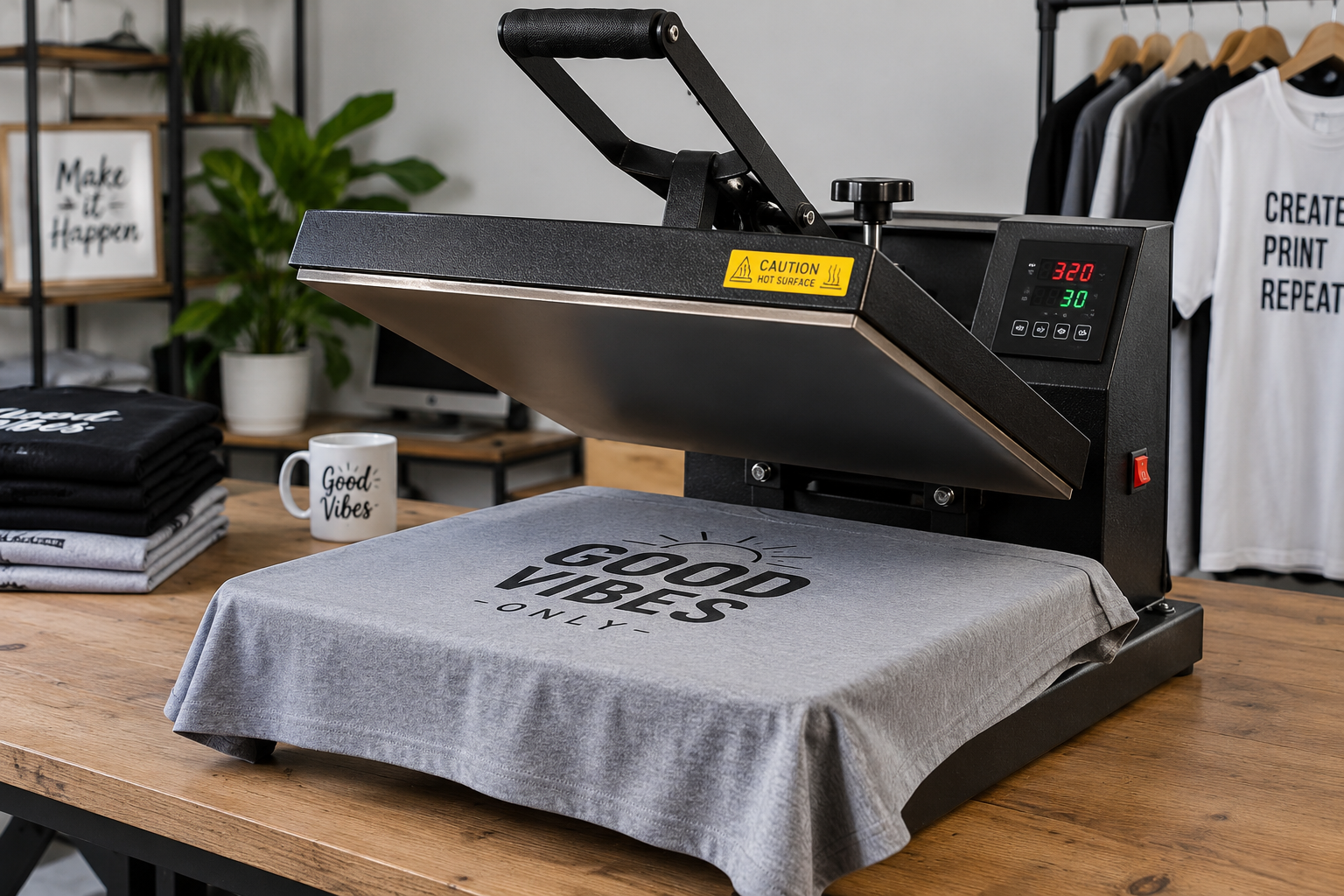
A heat press machine can make custom apparel, bags, accessories, and other printable products easier to produce with consistent heat and pressure. If you plan to create items for personal projects, an online shop, events, or a growing printing business, choosing the right equipment can affect your workflow and finished results.
Different machines vary in size, pressure adjustment, temperature controls, opening style, and compatible materials. Instead of focusing only on price, it helps to compare the features you are likely to use regularly.
What Should You Look for in a Heat Press Machine?
A heat press machine should match the products you intend to make, your available workspace, and how frequently you expect to use it. A compact model can make sense for occasional crafting, while higher-volume production may call for a larger platen, sturdier construction, and controls designed for repeated operation.
Before buying, consider these key areas:

- Platen dimensions
- Temperature range and consistency
- Adjustable pressure
- Timer controls
- Opening mechanism
- Available workspace
- Compatible transfer methods
- Expected production volume
- Manufacturer warranty and replacement parts
These details can help you narrow your options without paying extra for features that do not fit your projects.
Understanding Heat Press Sizes
Platen size determines how large an area you can press at one time. Small machines can work well for compact graphics, while larger presses give you more room for full-size shirt designs.
Common sizes include approximately 9 × 12, 12 × 15, and 15 × 15 inches, although manufacturers offer many other dimensions. A 15 × 15-inch press is commonly considered a versatile format because it can accommodate many standard apparel designs without occupying as much space as commercial-format equipment.
If you mainly need a heat press for shirts, check the typical dimensions of your artwork before choosing your platen. Larger does not automatically mean better. Bigger equipment usually requires more counter space and may cost more.
Clamshell vs. Swing-Away Heat Press Designs
The way a press opens can influence both workspace requirements and how easily you position garments.
A clamshell press has an upper platen that lifts upward at an angle. Its relatively compact footprint makes it useful when counter space is limited.
A swing-away design allows the upper platen to move away from the lower platen. This gives you more direct access to the work surface and can make positioning thicker materials easier. However, additional clearance around the machine is normally required.
There are also drawer-style presses with lower platens that slide outward. This design can provide easier access while keeping the heating element away from your hands during garment placement.
Why Temperature and Pressure Control Matter
Successful heat transfers depend heavily on the correct combination of temperature, pressure, and pressing time. Transfer-material manufacturers typically provide recommended settings for their products.
Digital controls can make it easier to set your desired temperature and pressing time. However, a digital display alone does not guarantee even heating. Build quality and heating-element design also matter.
Pressure adjustment deserves similar attention. A good heat transfer press should allow you to adapt pressure for different garments and transfer materials. Uneven pressure can contribute to incomplete adhesion or inconsistent results.
Always follow the transfer supplier’s instructions because recommended settings vary by material.
Choosing a Machine Based on Your Printing Method
Your transfer method should influence the equipment you buy. Heat-transfer vinyl, sublimation transfers, and other heat-applied graphics can have different requirements.
Heat-Transfer Vinyl
A vinyl heat press can be used to apply heat-transfer vinyl to compatible garments and textiles. This method is popular for names, numbers, logos, simple graphics, and personalized clothing.
Compared with a household iron, a dedicated press provides controlled temperature and pressure across a defined platen area. This can make your production process more repeatable.
Sublimation
A sublimation heat press is used to apply sublimation transfers to compatible substrates. Sublimation works particularly well with polyester fabrics and specially coated products.
Because sublimation ink becomes a gas when heated and bonds with compatible materials, temperature, time, and pressure should follow the instructions provided by the ink, transfer paper, blank, and equipment manufacturers.
Sublimation is commonly used for polyester apparel, mugs with suitable coatings, and other compatible blanks. Some products require dedicated attachments or presses rather than a standard flat platen.
Can You Use One Heat Press for Different Products?
In many cases, yes, but compatibility depends on the product.
A standard flat press can handle many flat items, such as shirts, tote bags, fabric panels, and certain flat blanks. Curved objects usually require equipment designed to accommodate their shape.
Some multifunction machines include attachments for mugs, hats, plates, or similar products. These systems can be appealing when you want to experiment with several product types without purchasing multiple standalone machines.
However, compare attachment quality and ease of use before buying. A dedicated machine can sometimes be more practical when one particular product accounts for most of your production.
Heat Press Features Worth Comparing
Shopping becomes easier when you separate essential features from convenient extras.
Adjustable Pressure
Pressure controls let you adapt the machine to different transfer materials and garment thicknesses. Check how easily pressure can be adjusted and how consistently the platen closes.
Digital Timer
A timer helps you follow the recommended pressing duration for each transfer. An audible notification can also be useful during repetitive production.
Temperature Controls
Clear temperature controls help you set the machine according to the transfer manufacturer’s specifications. Look for a display that is easy to read while you are working.
Replaceable or Interchangeable Platens
Some machines support different platen sizes or shapes. This can be useful if your product range expands.
Automatic Opening
Certain presses automatically release when the timer finishes. This feature may make repetitive jobs more convenient, particularly when you are preparing the next garment while another item is being pressed.
Heat Press Machine vs. T-Shirt Printing Machine
The terms are sometimes used interchangeably, but they can describe different equipment.
A t-shirt printing machine can refer broadly to equipment used to create printed shirts, including direct-to-garment printers and other printing technologies. A heat press applies controlled heat and pressure and may form one stage of the overall garment-decoration process.
For example, you may create or purchase a transfer first and then use the press to apply that design to the garment.
Understanding this distinction matters when budgeting. Buying a heat press does not necessarily provide every piece of equipment needed to create transfers from scratch.
What Materials Can You Heat Press?
Material compatibility depends on your transfer process and the instructions provided by the garment or blank manufacturer.
Common candidates can include:
- Cotton garments with compatible transfers
- Polyester apparel
- Cotton-polyester blends
- Tote bags
- Fabric panels
- Certain coated hard surfaces
- Compatible mouse pads
- Selected accessories
Some fabrics and coatings are sensitive to heat. Always confirm that the blank and transfer material can tolerate the required pressing conditions before production.
Testing a sample can be particularly useful when working with unfamiliar products.
How Much Workspace Do You Need?
Measure your work area before ordering a press. Do not consider only the machine’s listed dimensions.
You also need room to open the press, position garments, prepare transfers, and safely handle hot materials. Swing-away designs need additional side clearance, while clamshell machines generally use more vertical clearance.
Place the machine on a stable, heat-resistant work surface and follow the manufacturer’s electrical and ventilation requirements.
Choosing a Heat Press for a Small Business
If you plan to sell printed products, consider how the machine fits into your complete production workflow.
A custom printing machine should offer enough capacity for your realistic order volume without creating unnecessary expense or taking over your workspace.
Ask yourself:
How many products will you make?
Occasional custom orders may not require the same equipment as daily production.
What will you sell most often?
If shirts dominate your catalog, prioritize a platen size that accommodates your common garment designs.
Will you expand into other products?
Interchangeable platens or separate specialty presses may become useful as your catalog grows.
Can you get replacement parts?
Availability of components, technical support, and warranty service can become important if the machine is part of your regular business operations.
Should You Buy a Budget or Higher-Priced Heat Press?
Price should be considered alongside expected use.
An entry-level machine may suit occasional projects, testing a new product idea, or learning heat-transfer techniques. If you expect frequent production, features such as sturdy construction, consistent heating, accessible support, and replaceable components may become more important.
Before purchasing, compare:
- Platen dimensions
- Temperature specifications
- Pressure controls
- Opening mechanism
- Machine weight and footprint
- Warranty coverage
- Replacement-part availability
- Customer and technical support
- Included accessories
- Independent owner feedback
Avoid judging equipment by the number of accessories alone. Features you use every day usually provide more practical value than attachments that remain in storage.
What Else Do You Need With a Heat Press?
The press is only one part of a custom-printing setup. Your exact supplies depend on the transfer method you choose.
You may need:
- Compatible blank garments
- Heat-transfer vinyl
- Transfer or sublimation paper
- Appropriate printer and ink for applicable methods
- Cutting equipment for vinyl
- Protective sheets or paper when recommended
- Heat-resistant tape for applicable projects
- Design software
- Measuring and alignment tools
Check compatibility before purchasing supplies together. A transfer system works best when the printer, ink, paper, blank, and pressing process are designed to work with one another.
Common Heat Press Buying Mistakes to Avoid
One common mistake is choosing a machine based entirely on the lowest purchase price. A machine that cannot accommodate your typical designs or workload may quickly become limiting.
Another mistake is buying the largest model available without measuring your workspace. Larger platens can be useful, but they also increase the machine’s footprint.
You should also avoid assuming every transfer uses identical settings. Temperature, pressure, and time can vary substantially across transfer products and blanks.
Finally, consider support before purchasing. Access to instructions, warranty service, and replacement components may matter much more once the machine becomes part of your regular workflow.
Frequently Asked Questions
What size heat press is useful for shirts?
A 15 × 15-inch platen is a common general-purpose size for many shirt designs, but the best dimensions depend on your artwork, garment sizes, workspace, and production needs.
Can beginners use a heat press?
Yes. Many models have straightforward temperature, pressure, and timer controls. You still need to follow the machine’s safety instructions and the recommended settings for each transfer and blank.
Is a heat press useful for a small printing business?
It can be. A press may support custom apparel and other heat-applied products, but its suitability depends on your production volume, printing method, product selection, and budget.
Can a regular heat press be used for sublimation?
A flat press may be suitable for compatible flat sublimation blanks. The complete sublimation process also requires appropriate ink, transfer paper, and sublimation-compatible substrates. Curved products may require specialized equipment.
How long does a heat press take to apply a design?
Pressing times vary by transfer type and substrate. Instead of relying on one universal setting, use the instructions supplied by the transfer and blank manufacturers.
Finding the Right Heat Press for Your Projects
Choosing a heat press machine becomes simpler once you know what you intend to produce. Start with your transfer method, typical design size, workspace, and expected production volume. Then compare pressure adjustment, temperature controls, platen construction, warranty coverage, and available support.
A carefully selected machine can give you a practical foundation for experimenting with custom products or developing a more structured production workflow. Focus on the features you will actually use, verify material compatibility, and follow the recommended pressing settings for every transfer system.